

Well, back to writing these devblogs and launching them into the void, taking up precious kilobytes of data that could be used for cat videos. This week’s devblog topic, the Origins and Basis of Ordateig will be broken up into two parts, mostly because everything that could go wrong has been going wrong for me, and I still want to do the topic justice, since it the actual fictional language is the core of Zaehbet, Draad.
And for those curious in the results, there were a total of three votes… at least you three came to a unanimous agreement.
So, getting into the actual devblog, Ordateig was built under the core principle that it should be understandable by the average person, who should be able to understand the vibes of the language. I see a lot of fictional languages come up with their own unique writing systems, which are cool, don’t get me wrong, but I feel that moving to a custom writing system removes the easy ability for a person to know how a word sounds, and thus feels like.
To use a simple example, take the Minecraft enchanting language, also known as the Standard Galactic Alphabet:
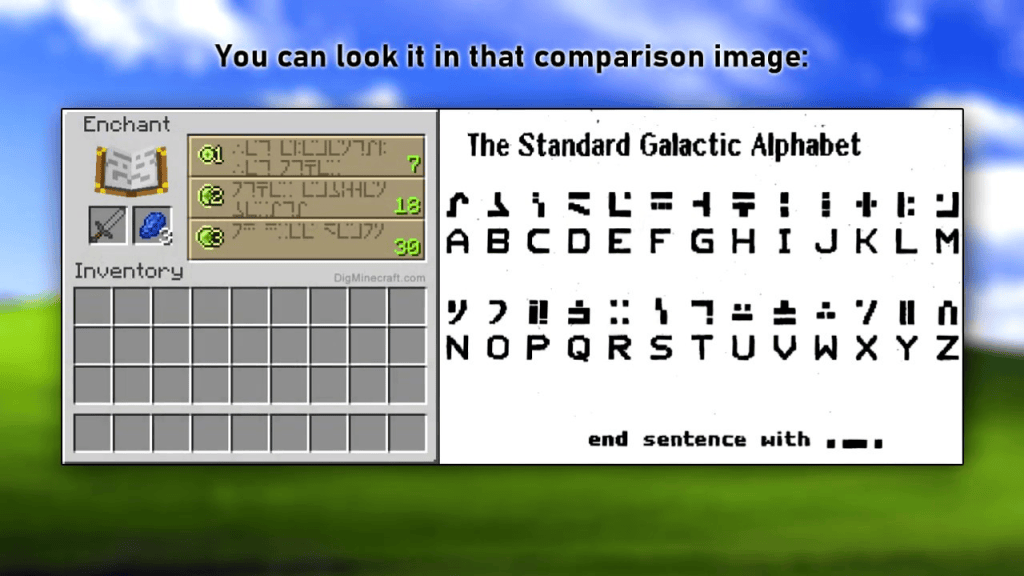
The average person does not know the Standard Galactic Alphabet, so they have no idea what the words actually are, or how they sound. The symbols do get across a certain mysticism, but I feel that, in the process, they lose the feelings we associate with sounds and certain letters.
Another major contributor to this decision is the somewhat famous Bouba and Kiki effect, where it was found that we associate different letters and sounds with different attributes. Overwhelmingly, when presented with the below shapes, people would name the round one Bouba and the sharp one Kiki.
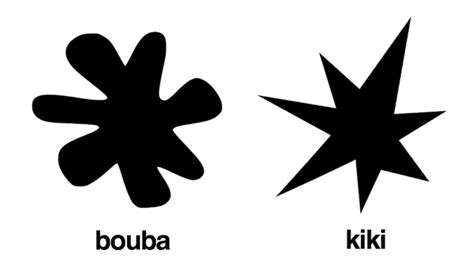
Thus, in creating Ordateig, I wanted to design a lot of the words off of the things we associate with different sounds, which would only really be possible if players knew how to approximately sound out the words in the first place.
If you’re really deep in linguistics, etymology, and conlangs, you may have noticed that a lot of the words in Ordateig are derived from the Indo-European language family, and there probably is some unintentional influence from emulating or attempting to get away from more widely-used languages like English.
The thing is that, ultimately, there are not that many sounds and phonemes that are universally viewed one way or another, like bouba and kiki. For example, the letter n is often associated with negativity, like No, Not, Negativity, Uncertain, but it isn’t actually a universal association, just one that became the most widespread due to the Indo-European languages usually using N phonemes. There are plenty of languages out there, like Chinese, which don’t have this association.
But, statistically, the vast majority of the players of Zaehbet, Draad will likely be a speaker of some Indo-European language (English, Spanish, French, Arabic, Hindi, etc), and so I ultimately made the decision to design some of the more instantly recognizable sounds around the associations Indo-European speakers have (such as the generally negative descriptor being Nat).
Welp, that’s all of the time I have to write on this topic today. The next devblog, which will be on this same topic, will be dropped next Friday, also at approximately 7 pm UTC. Additionally, the actual demo for Zaehbet, Draad (and the reason why I’m writing all of these), will be released on Thursday, October 8th, 7 pm UTC, so be ready to put on any thinking caps and play the demo when it drops.


Leave a comment